
From Notes to a Personal Operating System: Building My AI-Ready Second Brain
How I built Kage Archive: a personal operating system for fragmented notes, knowledge graphs, and AI-ready context using Obsidian, Markdown, and Git.
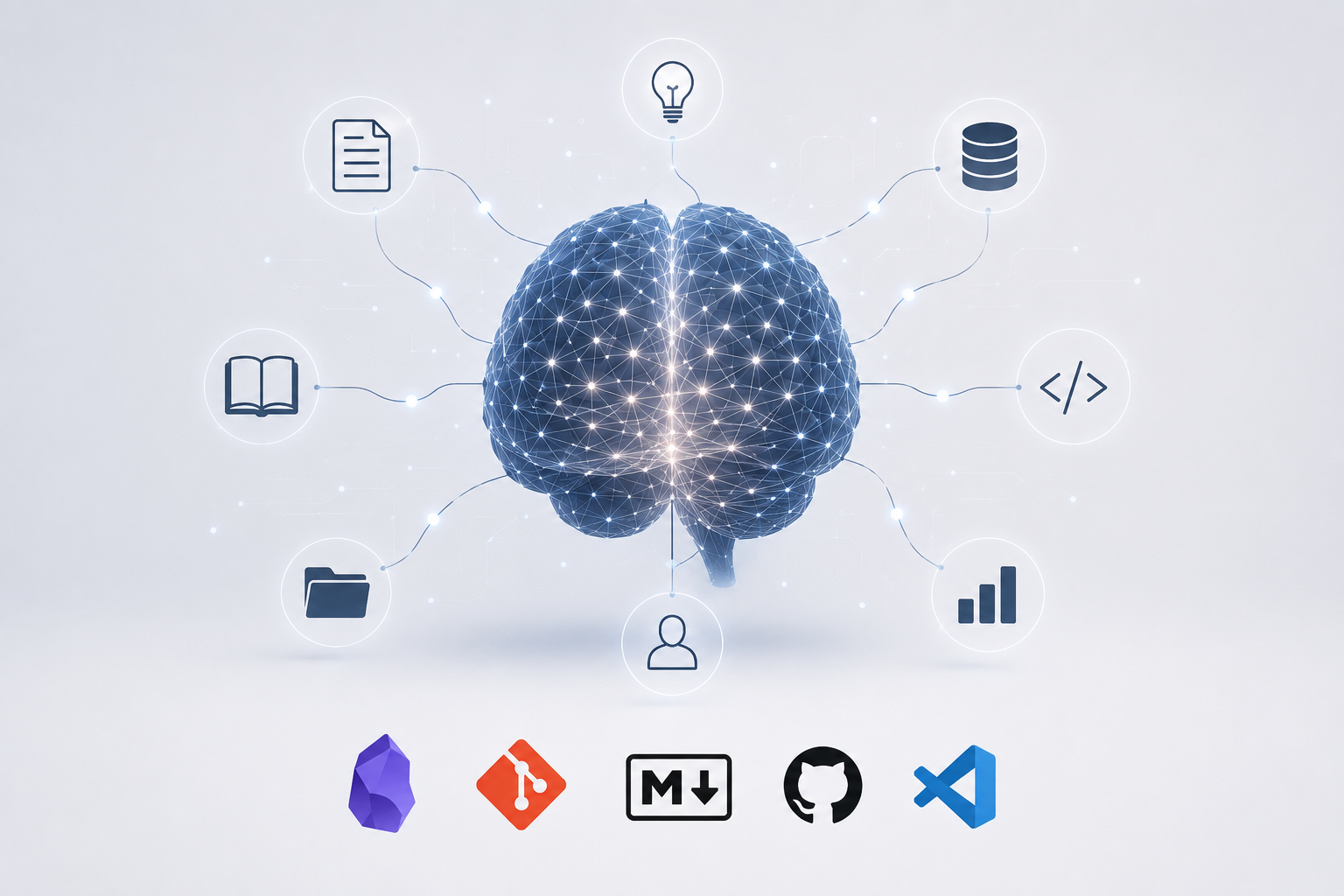
Introduction
For years, I thought my problem was organization.
My notes were everywhere.
My ideas lived inside Notion, Notes, GitHub repositories, WhatsApp conversations, Telegram messages, Google Docs, emails, bookmarks, ChatGPT chats, and countless unfinished projects.

Every time I started a new project, applied for an opportunity, wrote a proposal, prepared a presentation, or talked to an AI assistant, I had the same feeling:
I was starting from scratch.
Not because I lacked experience.
But because my experience was fragmented.
As a Product Engineer & Technical Lead, I had accumulated years of knowledge, projects, lessons, certifications, decisions, and goals.
The problem was simple:
None of it existed in a single place.
More importantly, none of it was structured in a way that could be understood by either humans or AI systems.
That realization led me to a question:
What if I could create a permanent system that contained everything important about who I am, what I have done, what I am doing, and where I am going?
That question became the foundation of a project I now call Kage Archive.
But before talking about Kage Archive, we need to talk about a much larger problem.
The problem of information fragmentation.
Chapter 1: The Information Fragmentation Problem
Today, most professionals do not live inside a single tool.
Instead, our knowledge is scattered across dozens of systems.
For me, information was distributed across:
- GitHub repositories
- Personal websites
- Google Drive
- Emails
- Calendars
- ChatGPT conversations
- Claude conversations
- Gemini conversations
- In local on my Mac
- Notes
- Documentation
- Project management tools
Each tool contained a piece of the puzzle.
But none of them contained the whole picture.
GitHub knew my code.
LinkedIn knew my professional history.
My calendar knew my commitments.
My notes knew my ideas.
My AI chats knew my thoughts.
Yet no system truly knew me.
The Hidden Cost of Fragmentation
At first, this doesn’t seem like a serious issue.
Until you need context.
Imagine trying to answer questions such as:
- What projects have I worked on in the last five years?
- What technologies do I actually master?
- What are my long-term goals?
- What lessons have I learned from previous failures?
- Which opportunities align with my values?
- What should I prioritize next?
The answers exist.
But they are scattered.
Finding them becomes an archaeological expedition through old notes, repositories, messages, and memories.

This creates what I call context debt.
The more experience you accumulate, the harder it becomes to access and use it effectively.
AI Made the Problem Worse
Ironically, the rise of AI assistants made this issue even more visible.
Tools like ChatGPT, Claude, Cursor, and GitHub Copilot are incredibly powerful.
But they suffer from one major limitation.
They do not know you.
Every conversation starts with partial context.
Every new chat begins with a blank slate.
Every project requires repeating information you have already explained dozens of times.
I realized that AI systems were not lacking intelligence.
They were lacking memory.
And if AI is going to become a long-term collaborator, then memory becomes a first-class problem.
That observation changed the direction of my research entirely.
I stopped searching for better note-taking tools.
I started searching for a personal memory system.
Chapter 2: The Search for a Better System
At the beginning, I thought I needed a better note-taking application.
Like many developers and knowledge workers, I experimented with multiple tools over the years.
Every new tool promised the same thing:
- Better organization
- Better productivity
- Better knowledge management
Yet after a few months, I always ended up in the same situation.
More notes.
More folders.
More information.
But not necessarily more understanding.
I wasn’t looking for a place to store information.
I was looking for a system capable of representing who I am, what I know, what I have built, and where I am going.
Discovering the Concept of a Second Brain
My research eventually led me to the concept of a Second Brain, popularized by Tiago Forte.
The idea is simple:
Build an external system that captures, organizes, and retrieves knowledge so your biological brain can focus on thinking rather than remembering.
The concept immediately resonated with me.
As engineers, we already externalize memory through:
- Source control
- Documentation
- Databases
- Infrastructure as Code
Why shouldn’t we do the same with our personal knowledge?
The Second Brain movement introduced important ideas:
- Knowledge capture
- Progressive summarization
- Information retrieval
- Long-term thinking
But I still felt something was missing.
Exploring Existing Approaches
Notion

Notion was my first serious attempt.
I loved:
- The flexibility
- The databases
- The templates
- The collaboration features
But over time I realized something.
Notion felt like a workspace.
Not a brain.
The information was structured, but it remained largely disconnected.
More importantly, I was uncomfortable placing my entire digital identity inside a proprietary cloud platform.
Obsidian

Obsidian was different.
For the first time, I encountered the idea of a knowledge graph.
Notes could be linked.
Relationships could be visualized.
Information could behave more like a network than a hierarchy.
This was a major breakthrough.
I began to understand that knowledge is not merely stored.
Knowledge is connected.
Roam Research and Logseq
I also explored tools such as:


Both introduced fascinating concepts:
- Bidirectional links
- Networked thought
- Knowledge graphs
These systems moved closer to how humans actually think.
Ideas are rarely isolated.
They exist within relationships.
Digital Gardens
Another concept that influenced my thinking was the idea of a Digital Garden.
Unlike a blog, which publishes finished ideas, a digital garden embraces continuous growth.
Notes evolve.
Ideas mature.
Knowledge becomes a living system.
I liked this philosophy because it reflected how learning actually works.
We rarely move from ignorance to certainty in a single step.
Most understanding develops gradually.
The Problem None of These Systems Solved
Despite their strengths, I kept encountering the same limitation.
All these systems focused on knowledge.
None of them focused on identity.
They helped answer questions like:
- What do I know?
- What have I learned?
But they struggled to answer questions like:
- Who am I?
- What are my values?
- What are my goals?
- What projects am I currently pursuing?
- How do I make decisions?
- What kind of life am I trying to build?
The more I thought about it, the more I realized something important.
A human being is not just a collection of notes.
A human being is a combination of:
- Identity
- Experience
- Skills
- Goals
- Relationships
- Decisions
- Beliefs
- Projects
None of the existing systems treated all of these elements as first-class citizens.
Chapter 3: The AI Revolution Changes Everything
For years, knowledge management systems were designed for one user.
The human.
The assumption was simple:
Capture information so that your future self can find it later.
That made perfect sense in a world where humans were the only consumers of knowledge.
But then something changed.
AI assistants arrived.
Tools like ChatGPT, Claude, Cursor, Gemini, and GitHub Copilot introduced a completely new way of interacting with information.
For the first time, we could collaborate with systems capable of reasoning, generating ideas, writing code, reviewing documents, and helping us make decisions.
Yet after hundreds of interactions, I noticed a recurring pattern.
The AI was intelligent.
But it was also forgetful.
The Memory Problem
Every conversation started from scratch.
I would explain:
- My background
- My projects
- My goals
- My business activities
- My preferred technologies
Then I would repeat the process again in another tool.
And again.
And again.
ChatGPT knew part of my story.
Claude knew another part.
Cursor knew my codebase.
GitHub knew my repositories.
LinkedIn knew my career history.
None of them knew the complete picture.
The problem was no longer knowledge management.
The problem was memory management.
Intelligence Without Memory
Imagine meeting a brilliant consultant every day.
Every morning, the consultant forgets:
- Who you are
- What you do
- What you learned yesterday
- What your goals are
- What projects you are working on
The consultant remains intelligent.
But collaboration becomes inefficient.
This is how most AI systems currently operate.
Their reasoning capabilities are impressive.
Their memory capabilities remain limited.
The result is constant context reconstruction.
Humans repeatedly explain themselves.
AI repeatedly rebuilds understanding.
Both sides waste energy.
Context Is Becoming More Valuable Than Prompts
Early AI adoption focused heavily on prompting.
People searched for:
- Better prompts
- Prompt libraries
- Prompt engineering techniques
These were useful.
But over time I realized something.
A perfect prompt cannot compensate for missing context.
The quality of an AI response depends not only on the instruction.
It also depends on the information available.
A highly capable AI with poor context often produces mediocre results.
A highly capable AI with rich context becomes dramatically more useful.
This observation led me toward a concept that is becoming increasingly important:
Context Engineering.
Context Engineering
Prompt Engineering asks:
What should I ask the AI?
Context Engineering asks:
What should the AI know before I ask?
The difference is subtle but profound.
Instead of focusing only on instructions, Context Engineering focuses on building a rich and accurate representation of reality.
For example:
A generic AI can help write a business plan.
An AI that understands:
- My career history
- My skills
- My values
- My current projects
- My long-term vision
- My decision framework
can provide dramatically better guidance.
The AI is not becoming smarter.
It is becoming more informed.
Beyond the Second Brain
Most Second Brain systems focus on knowledge.
Kage Archive focuses on identity.
Knowledge is important.
But knowledge alone is insufficient.
A useful representation of a person includes:
- Identity
- Experience
- Skills
- Goals
- Values
- Decisions
- Relationships
- Projects
- Vision
These elements create context.
And context creates better decisions.
The Emergence of Personal Operating Systems
At this point, I realized I was no longer building a note-taking system.
I was building something closer to a Personal Operating System.
An operating system provides:
- Structure
- Organization
- Rules
- Memory
- Interfaces
Kage Archive was evolving into exactly that.
A system capable of acting as:
- Personal memory
- Knowledge repository
- Decision support system
- Founder dashboard
- AI context layer
All stored in a format that both humans and machines could understand.
Chapter 4: Designing Kage Archive
The Design Challenge
Once I had identified the problem, I faced a new question:
If I wanted to create a permanent memory layer for both myself and future AI systems, what would it look like?
At first, I considered building a custom application.
As software engineers, our instinct is often to solve problems with more software.
But the more I thought about it, the more I realized something important.
The most important part was not the application.
The most important part was the information architecture.
A poorly structured system remains poorly structured regardless of the technology behind it.
Before choosing tools, I needed principles.
Design Principles
I established five principles that would guide every decision.
1. Local First
My personal knowledge should belong to me.
I did not want my entire identity, experience, and decision-making framework locked inside a proprietary cloud platform.
The archive should remain accessible even if a company disappears tomorrow.
2. Human Readable
A human should be able to open any file and understand it immediately.
No proprietary formats.
No complex databases.
No hidden structures.
Just plain text.
3. AI Readable
The system should be easily consumable by:
- ChatGPT
- Claude
- Cursor
- Copilot
- Future AI agents
The easier the information is to parse, the more useful it becomes.
4. Future Proof
I wanted a system that could survive decades.
Technology changes.
Companies disappear.
Formats become obsolete.
Text files have survived every technological revolution so far.
5. Version Controlled
Knowledge evolves.
Goals evolve.
Identity evolves.
I wanted a complete history of those changes.
Why Markdown Won
After evaluating multiple approaches, Markdown became the obvious choice.
Markdown is:
- Simple
- Portable
- Human-readable
- AI-friendly
- Future-proof
Every note in Kage Archive is a Markdown file.
This means the archive can be opened by:
- Obsidian
- VS Code
- Cursor
- GitHub
- Terminal editors
- Future tools that do not exist yet
The archive is not dependent on any specific application.
The data comes first.
The tools come second.
Why Git Became Essential
Most note-taking systems focus on storage.
Few focus on history.
As an engineer, this felt strange.
We would never manage software without version control.
Why should personal knowledge be different?
Git provided several advantages:
Complete History
Every change is tracked.
Experimentation
Ideas can evolve safely.
Backup
The entire archive can be replicated easily.
Transparency
I can see exactly how my thinking evolves over time.
Git transformed Kage Archive from a collection of notes into an evolving system.
Why Obsidian
Markdown and Git solved storage.
I still needed a user interface.
Obsidian became the natural choice.
Not because it is the most feature-rich note-taking application.
But because it respects ownership.
Obsidian treats files as files.
The data remains accessible outside the application.
This aligns perfectly with the principles of Kage Archive.
The Knowledge Graph
One feature immediately stood out.
The graph view.
For the first time, I could visualize relationships between ideas.
This changed my perspective.
A human life is not a folder hierarchy.
It is a network.
My goals influence my decisions.
My experiences influence my skills.
My skills influence my opportunities.
My opportunities influence my future.
The graph made these relationships visible.
Moving Beyond Folders
Traditional organization relies heavily on folders.
Kage Archive uses folders, but folders are only the first layer.
The second layer is relationships.
For example:
Biography connects to:
- Mission
- Values
- Education
- Career Timeline
Career Timeline connects to:
- Current Missions
- Skills
- Projects
Business Ideas connect to:
- Revenue
- Career Vision
- Future Plans
The archive gradually becomes a knowledge graph rather than a file system.
The Birth of AGENTS.md
As the archive evolved, I realized something unusual.
The archive was not only for me.
It was also for AI.
This led to the creation of a file called:
AGENTS.md
The purpose of this document is simple:
Teach AI systems how to interact with Kage Archive.
It defines:
- Editing rules
- Update policies
- Knowledge management standards
- Collaboration principles
In other words:
The archive contains instructions for its future collaborators.
README.md as an Entry Point
Every operating system needs an entry point.
For Kage Archive, that role belongs to README.md.
The README answers:
- What is Kage Archive?
- Why does it exist?
- How is it organized?
- How should it be used?
Any human or AI entering the system should begin there.
From Notes to an Operating System

At this stage, something interesting happened.
Kage Archive stopped feeling like a collection of notes.
It started feeling like an operating system.
It contained:
- Identity
- Experience
- Goals
- Decisions
- Knowledge
- Business information
- Relationships
More importantly, it provided a framework for how these elements interact.
I was no longer building a second brain.
I was building a representation of myself.
And that changed everything.
Chapter 5: Building the Knowledge Architecture
Once the technical foundations were in place, I faced a new challenge.
How should information be organized?
Most note-taking systems focus on categories.
Work.
Personal.
Ideas.
Projects.
Resources.
This approach works initially.
But as the volume of information grows, folders become increasingly disconnected from reality.
A human life is not organized into neat categories.
Everything influences everything else.
My career affects my goals.
My goals affect my decisions.
My decisions affect my projects.
My projects affect my skills.
The architecture needed to reflect these relationships.
Designing Around Questions
Instead of organizing information by file type, I organized it around fundamental questions.
Every important piece of information in Kage Archive exists to answer one of these questions:
Who am I?
What have I done?
What am I doing now?
What do I know?
Where am I going?
How do I make decisions?
What am I building?
These questions became the foundation of the architecture.
Core Identity
The first layer of the system is identity.
This section answers:
Who am I?
It contains documents such as:
- Biography
- Mission
- Values
- Personal Principles
- Anti-Goals
- Decision Framework
- Education
- Certifications
- Languages
This is arguably the most important part of the entire archive.
Before discussing projects, technologies, or opportunities, I believe it is important to understand the person behind them.
Many decisions become easier when values and principles are explicitly documented.
Experience
The second layer answers:
What have I done?
This section contains:
- Career Timeline
- Professional Roles
- Projects
- Achievements
Experience is more than a résumé.
It is a record of lessons learned.
Most professionals accumulate valuable experience but rarely structure it in a way that can be reused.
Kage Archive treats experience as reusable knowledge.
Current Missions
The third layer answers:
What am I doing right now?
This includes:
- Active clients
- Current responsibilities
- Revenue sources
- Ongoing initiatives
This section functions as a living operational dashboard.
Unlike a résumé, it evolves continuously.
Skills & Stack
The fourth layer answers:
What can I actually do?
This includes:
- Technical Skills
- Leadership Skills
- Product Skills
- AI & Automation Skills
The goal is not to list technologies.
The goal is to describe capabilities.
Frameworks change.
Capabilities remain.
Founder Dashboard
The fifth layer answers:
What is actually compounding?
This section contains:
- Revenue
- Assets
- Opportunities
- Business Ideas
- Content Strategy
This is where Kage Archive begins to differ significantly from traditional knowledge systems.
Most note-taking systems focus on information.
Founder Dashboard focuses on value creation.
Future Plans
The sixth layer answers:
What am I planning to build?
This includes:
- SaaS ideas
- Digital products
- Future studies
- Content initiatives
Not every idea deserves execution.
But every idea deserves a place where it can mature.
Grand Vision
The seventh layer answers:
Where am I going?
This section contains:
- Life Goals
- Career Vision
- Financial Vision
- Geography Vision
- Legacy
This layer acts as a compass.
When opportunities appear, they can be evaluated against the direction I want my life to take.
Decision Journal
One of the most underrated components of the system is the Decision Journal.
Most people remember decisions.
Few remember why they made them.
Every significant decision can be documented with:
- Context
- Alternatives
- Reasoning
- Expected Outcome
- Review Date
Over time, this creates a feedback loop that improves judgment.
Idea Vault
Ideas are fragile.
Many disappear because they are never captured.
The Idea Vault serves as a temporary home for:
- Startup ideas
- Product concepts
- Observations
- Research notes
Ideas are not commitments.
They are possibilities.
This distinction is important.
Relationships Create the Brain
Initially, the archive looked like a collection of folders.
Then I discovered something important.
Knowledge is not stored in documents.
Knowledge exists in relationships.
A mission connects to values.
Values connect to decisions.
Decisions connect to projects.
Projects connect to skills.
Skills connect to opportunities.
Opportunities connect to future goals.
The real power of Kage Archive emerged when these relationships became explicit through links and knowledge graphs.
At that point, the archive stopped behaving like a file system.
It started behaving like a brain.
A Representation of a Human
Looking at the architecture today, I no longer see folders.
I see a representation of a person.
Not a perfect representation.
Not a complete representation.
But a system capable of describing:
- Identity
- Experience
- Knowledge
- Ambition
- Decisions
- Direction
In a format understandable by both humans and machines.
That was the real objective from the beginning.
Not better note-taking.
Better self-representation.
Chapter 6: Turning Notes Into a Knowledge Graph
When I first started building Kage Archive, I organized everything using folders.
The structure looked clean.
Identity.
Experience.
Projects.
Skills.
Goals.
Vision.
At first glance, everything seemed organized.
But after a few days, I noticed a problem.
The archive looked more like a file cabinet than a brain.
Information was stored.
But it wasn’t connected.
A human brain does not work like a folder hierarchy.
When you think about a project, your brain simultaneously activates:
- Past experiences
- Lessons learned
- People involved
- Skills required
- Future goals
- Emotions
- Related ideas
Everything is connected.
My archive needed to reflect that reality.
Knowledge Is a Network
One of the clearest things this project forced me to notice is:
Knowledge is not stored in documents.
Knowledge exists in relationships.
A note by itself contains information.
A note connected to ten other notes contains context.
And context is where meaning emerges.
For example:
My Career Vision is connected to:
- Life Goals
- Financial Vision
- Business Ideas
- Current Missions
My Current Missions are connected to:
- Revenue
- Technical Skills
- Leadership Skills
- Future Opportunities
My Values influence:
- Decisions
- Partnerships
- Projects
- Goals
The archive was not supposed to be a collection of files.
It was supposed to be a network.
Discovering Bidirectional Links
This is where Obsidian introduced one of the most powerful concepts I had encountered.
Bidirectional links.
Instead of merely creating folders, I could connect ideas directly.
For example:
Biography links to Mission.
Mission links to Values.
Values link to Decision Framework.
Decision Framework links to Career Vision.
Career Vision links to Business Ideas.
Business Ideas link to Revenue.
Revenue links back to Current Missions.
Suddenly, information stopped being isolated.
It started behaving like a system.
Maps of Content (MOCs)
As the archive grew, another challenge emerged.
Navigation.
I had dozens of files.
Soon I would have hundreds.
Finding information through folders alone would eventually become difficult.
This led me to discover a concept popular within the Obsidian community:
Maps of Content, often called MOCs.
A Map of Content is essentially a hub.
Instead of searching through folders, you navigate through relationships.
For example:
Core Identity becomes a hub connecting:
- Biography
- Mission
- Values
- Principles
- Education
- Certifications
Founder Dashboard becomes a hub connecting:
- Revenue
- Assets
- Opportunities
- Business Ideas
The result feels much more natural.
Instead of navigating a file system, you navigate ideas.
Creating a Central Node
One challenge remained.
Every knowledge graph needs a center.
A starting point.
A reference node.
For Kage Archive, that node became:
Freddy Agbona
Not the biography.
Not the résumé.
The person.
Every major section of the archive eventually connects back to that central node.
Identity.
Experience.
Skills.
Projects.
Goals.
Vision.
Everything originates from and contributes to the same individual.
This creates a structure that resembles a living system rather than a collection of documents.
The Graph View Moment

One evening, after creating enough links, I opened Obsidian’s Graph View.
For the first time, I could see the archive visually.
What appeared on the screen surprised me.
I no longer saw folders.
I saw relationships.
Clusters began forming naturally.
Identity became one cluster.
Skills became another.
Current missions formed their own network.
Business ideas connected to vision.
Vision connected to decisions.
Decisions connected to actions.
The graph was beginning to resemble a digital representation of my life.
That was the moment Kage Archive stopped feeling like a note-taking project.
It started feeling like a second brain.
Chapter 7: Creating an AI-Ready Brain
The Realization
While building Kage Archive, I noticed something unexpected.
The archive was becoming increasingly useful to me.
But it was becoming even more useful to AI.
Every new document added:
- Context
- History
- Structure
- Relationships
The archive was gradually becoming a representation of who I am.
And if it could represent me to myself, it could also represent me to artificial intelligence.
That realization changed how I thought about the entire project.
I was no longer building a Second Brain.
I was building a collaboration layer.
AI Does Not Need More Intelligence
One of the most common assumptions about AI is that future progress will come primarily from more powerful models.
Larger models.
Smarter models.
More reasoning capabilities.
While these improvements matter, I believe another factor may become equally important:
Context.
Most AI systems today are extremely capable.
Their limitation is often not intelligence.
Their limitation is understanding the person they are helping.
An AI can help write a business plan.
But an AI that understands:
- My skills
- My projects
- My values
- My goals
- My constraints
can provide far more relevant guidance.
The difference is not intelligence.
The difference is context.
Why Every AI Needs an Entry Point
Imagine hiring a new employee.
On their first day, they know nothing about:
- Your company
- Your goals
- Your processes
- Your priorities
The first thing you would do is onboarding.
You would provide context.
AI systems face the same challenge.
Without context, every interaction starts from zero.
This led me to an important design principle:
Every intelligence system needs an entry point.
For Kage Archive, that entry point became:
README.md
Teaching AI How to Collaborate
As the archive evolved, another problem emerged.
Even if an AI could access the archive, how should it behave?
Should it create files?
Modify files?
Delete information?
Challenge assumptions?
Act as a passive assistant?
Or as a strategic advisor?
These questions led to the creation of another document:
AGENTS.md
AGENTS.md
If README.md explains the system,
AGENTS.md explains the rules.
This file defines:
- How AI should interact with the archive
- What information can be modified
- What information should be preserved
- How updates should be documented
- How collaboration should occur
In other words:
The archive contains instructions for its future collaborators.
This idea fascinated me.
For the first time, I was writing documentation not only for humans, but also for artificial intelligence.
AI Collaboration Rules
Over time, I expanded this concept further.
I created documents defining:
- Decision-making principles
- Core values
- Anti-goals
- Collaboration preferences
The objective was simple.
If an AI assistant understands:
- What I value
- What I am trying to build
- What mistakes I want to avoid
then its recommendations become dramatically more useful.
The AI stops acting like a generic assistant.
It starts acting like a contextualized collaborator.
The Emergence of Personal Memory Layers
While researching this topic, I realized something interesting.
Many people are beginning to explore similar ideas.
Different names exist:
- AI Memory
- Personal Knowledge Systems
- Context Engineering
- Digital Twins
- Personal Operating Systems
Despite the different terminology, they all point toward a similar future.
A future where humans maintain structured representations of themselves that AI systems can understand and use.
Beyond Notes and Knowledge Management
At this point, calling Kage Archive a note-taking system felt inaccurate.
Calling it a Second Brain felt incomplete.
The archive was becoming something larger.
It contained:
- Identity
- Knowledge
- Experience
- Projects
- Vision
- Decision frameworks
- Business context
It was evolving into a personal memory layer.
A system capable of providing continuity across tools, projects, and years.
A Glimpse of the Future
Today, Kage Archive is primarily a collection of Markdown files.
Tomorrow, it may become much more.
I can imagine a future where:
- AI assistants read the archive automatically
- Projects update the archive continuously
- Decisions are logged and analyzed
- Personal knowledge becomes searchable through AI
- Context follows me across every tool I use
The archive could become the foundation of a personal MCP server, an AI memory system, or a digital operating layer that persists independently of any single application.
The Long-Term Vision
The ultimate goal is not to create perfect documentation.
The goal is continuity.
Continuity of knowledge.
Continuity of identity.
Continuity of context.
Humans forget.
Tools change.
Companies disappear.
Technologies evolve.
But a personal memory system can still be useful across those changes.
That continuity is what I care about more than the tools themselves.
Kage Archive is my attempt to keep that continuity somewhere durable.
Chapter 8: What I Got Wrong at First
When I started Kage Archive, I assumed the difficult part would be technical.
Choosing tools.
Designing folders.
Creating structures.
Integrating Git.
Configuring Obsidian.
I was wrong.
The technical part was relatively easy.
The difficult part was deciding what deserved to be remembered.
Building a useful memory system forces you to answer uncomfortable questions:
- What matters?
- What doesn’t?
- What should be preserved?
- What should be forgotten?
The challenge was never storage.
The challenge was intentionality.
Mistake #1: Thinking Organization Was the Goal
At the beginning, I was obsessed with structure.
Folders.
Subfolders.
Naming conventions.
Templates.
Taxonomies.
Everything looked organized.
But something felt wrong.
The archive was becoming a well-organized filing cabinet.
Not a brain.
I eventually realized:
Organization is useful.
Relationships are essential.
The moment I started focusing on connections instead of categories, the archive became significantly more valuable.
Mistake #2: Treating Notes as the Final Product
For years, I accumulated notes.
Articles.
Ideas.
Meeting notes.
Random thoughts.
Like many people, I assumed note collection was progress.
But collecting information is not the same as creating knowledge.
Most notes never become useful because they remain isolated.
The value appears when notes are connected to:
- Decisions
- Projects
- Goals
- Experiences
Knowledge emerges from relationships, not accumulation.
Mistake #3: Ignoring Identity
Most personal knowledge management systems focus heavily on information.
Very few focus on identity.
When I started documenting:
- Values
- Mission
- Principles
- Anti-goals
- Decision frameworks
something unexpected happened.
Decision making became easier.
Because I was no longer evaluating opportunities against emotions.
I was evaluating them against documented principles.
Identity turned out to be more important than information.
Mistake #4: Thinking the System Was for Me Alone
Originally, Kage Archive was intended as a personal system.
A place to store knowledge.
A place to think.
A place to plan.
Then AI entered the picture.
Suddenly, every design decision changed.
Questions emerged that I had never considered before:
- Can an AI understand this file?
- Is this information structured?
- Does this document provide context?
- Would another system understand this relationship?
The archive stopped being a private notebook.
It became a shared interface between a human and intelligent systems.
What Surprised Me Most
The biggest surprise was not technical.
It was psychological.
Documenting my life forced me to clarify it.
Writing down:
- Goals
- Values
- Career vision
- Financial vision
- Anti-goals
revealed inconsistencies.
Some ambitions were genuine.
Others were inherited from external expectations.
Some projects aligned with my vision.
Others did not.
The archive became a mirror.
And mirrors can be uncomfortable.
The Anti-Goals Discovery
One of the most valuable documents I created was not a goals document.
It was an anti-goals document.
Everyone talks about:
- What they want
- Where they want to go
- What they want to achieve
Few people document what they refuse to become.
For me, anti-goals included:
- Trading all my time for money
- Losing geographic freedom
- Sacrificing mental health
- Building things nobody wants
- Working with people who ignore boundaries
These anti-goals became surprisingly useful filters.
Sometimes knowing what to avoid is more important than knowing what to pursue.
What stuck with me
The part that stuck has nothing to do with Obsidian.
Or Git.
Or Markdown.
Or AI.
It is this:
Most people spend years building careers.
Very few spend time writing down who they are becoming.
Kage Archive made me treat identity like something worth structuring.
Not because documentation is important.
But because clarity is useful.
The clearer I get about who I am, the easier it becomes to decide what to build, what to pursue, and what to ignore.
And when information keeps piling up everywhere, that clarity starts to matter more than another tool.
Chapter 9: The Future
Kage Archive Is Not the End Goal
When people see Kage Archive for the first time, they often focus on the tools.
Obsidian.
Git.
Markdown.
GitHub.
Knowledge graphs.
But those tools are not the interesting part.
The interesting part is what they make possible.
Kage Archive is not the destination.
It is a prototype.
An experiment.
A first attempt at answering a question that I believe will become increasingly important over the next decade:
How should humans manage their personal context in an AI-native world?
I do not think we have the answer yet.
But I believe we are beginning to discover the right questions.
The Shift From Information to Context
For decades, the challenge was information.
How do we store it?
How do we search it?
How do we organize it?
Those problems are largely solved.
Today, storage is cheap.
Search is powerful.
Access is nearly instantaneous.
The new challenge is context.
Information answers:
What happened?
Context answers:
Why does it matter?
As AI systems become more capable, context becomes increasingly valuable.
The people who can provide rich, structured context will likely extract far more value from AI than those who cannot.
The Rise of Personal Memory Systems
I believe we are entering an era where personal memory systems will become common.
Not because people enjoy documentation.
But because context compounds.
Imagine an AI assistant that understands:
- Your career history
- Your projects
- Your goals
- Your values
- What you’ve been learning
- Your decision patterns
Not because you explain them every day.
But because the information already exists in a structured system.
The quality of collaboration changes dramatically.
The conversation begins where the previous one ended.
Instead of repeatedly rebuilding context, you continue building knowledge.
MCP and Structured Context
One concept that particularly interests me is the Model Context Protocol (MCP).
At a high level, MCP enables AI systems to access external context in a standardized way.
Today, Kage Archive is a collection of Markdown files.
Tomorrow, it could become a context server.
A system capable of providing:
- Identity
- Knowledge
- Project history
- Goals
- Documentation
to any AI assistant that needs it.
Instead of manually copying context into conversations, context becomes accessible through a structured interface.
The implications are significant.
Not only for individuals.
But for teams, companies, and entire organizations.
Personal AI Infrastructure
Most people think of AI as an application.
I increasingly think of AI as infrastructure.
Just as we have:
- Email infrastructure
- Cloud infrastructure
- Development infrastructure
I believe we will eventually have:
Personal AI Infrastructure.
Systems designed to maintain continuity across tools, devices, and years.
Kage Archive is my first attempt at building such infrastructure for myself.
Digital Twins
Another concept that fascinates me is the idea of digital twins.
In industry, a digital twin is a virtual representation of a physical system.
What would a personal digital twin look like?
Not a clone.
Not a replacement.
But a structured representation of:
- Knowledge
- Experience
- Goals
- Preferences
- Context
A system capable of helping humans think, decide, and create more effectively.
Kage Archive is nowhere near that level.
But I can see a path leading there.
Human-AI Collaboration
Much of the discussion around AI focuses on replacement.
Will AI replace developers?
Will AI replace designers?
Will AI replace writers?
I find a different question more interesting:
How can humans and AI collaborate more effectively?
Collaboration requires understanding.
Understanding requires context.
And context requires memory.
This is ultimately why Kage Archive exists.
Not to compete with AI.
To collaborate with it.
The Long-Term Vision
Fifteen years from now, I imagine a very different workflow.
When starting a project, I do not want to explain:
- Who I am
- What I know
- What I have built
- What I care about
I want those things to already be understood.
I want my tools to have continuity.
I want knowledge to compound.
I want decisions to benefit from years of accumulated experience.
Most importantly, I want technology to amplify human potential rather than continuously reset it.
Why I Built Kage Archive
At the beginning of this article, I described a feeling.
The feeling of constantly starting from scratch.
New project.
New conversation.
New opportunity.
New AI session.
Always rebuilding context.
Kage Archive was my attempt to solve that problem.
Not through more productivity.
Not through more notes.
But through continuity.
Continuity of knowledge.
Continuity of identity.
Continuity of experience.
Continuity of context.
Final Thoughts
The tools will change.
Obsidian may disappear.
GitHub may evolve.
New AI systems will emerge.
New protocols will be created.
None of that matters as much as the underlying idea.
The idea that a human being can intentionally build a structured representation of their knowledge, experiences, goals, and decisions.
A system that grows alongside them.
A system that helps them think.
A system that helps them learn.
A system that helps them collaborate with increasingly intelligent technologies.
Kage Archive is my attempt to build such a system.
Perhaps in a few years, we will look back and see it as a primitive prototype.
Or perhaps it will become the foundation of something much larger.
Either way, building it already changed how I think about knowledge, identity, and working with AI.
And I suspect I am only at the beginning.
Conclusion
When I started this, I thought I was building a better note-taking system.
I thought the problem was organization.
I thought the solution would be a combination of tools, folders, and workflows.
I was wrong.
The real problem was continuity.
Over the years, I accumulated experiences, projects, lessons, skills, ambitions, and decisions.
But those pieces of information were scattered across dozens of tools and platforms.
Each tool knew something about me.
None of them knew the whole story.
The more experience I gained, the harder it became to access and use that experience effectively.
What started as a search for a Second Brain gradually became something else.
A search for a system capable of representing a person.
Not perfectly.
Not completely.
But sufficiently enough to preserve context over time.
That search led to Kage Archive.
A local-first repository built with Markdown, Git, GitHub, and Obsidian.
A system designed not only to store information, but to capture relationships.
Not only to preserve knowledge, but to preserve context.
Not only for myself, but for the AI systems I increasingly collaborate with every day.
The surprising part was that building the system forced me to clarify my own life.
You cannot document your goals without thinking about your direction.
You cannot document your values without questioning your decisions.
You cannot document your vision without confronting your priorities.
In that sense, Kage Archive became much more than a knowledge management project.
It became a place to think.
A mirror.
A map.
And increasingly, something closer to an operating system.
I do not think Kage Archive is the final answer.
I suspect it is an early prototype of something that does not fully exist yet.
A setup where people keep structured personal context.
Where AI systems understand us less through isolated prompts, and more through persistent memory.
Where knowledge, identity, goals, and experience sit in one place humans and tools can both use.
Maybe that arrives through MCP servers.
Maybe through personal AI infrastructure.
Maybe through technologies we have not imagined yet.
What matters to me is simpler.
Context matters.
Memory matters.
Continuity matters.
And as AI keeps showing up in more of my work, being able to keep that context around feels less optional.
Kage Archive is my attempt to start.
Useful Resources & Further Reading
The ideas presented in this article are heavily influenced by several communities, books, and emerging disciplines around knowledge management, personal systems, and artificial intelligence.
If you want to explore these concepts further, here are some excellent starting points.
Second Brain
The concept of a Second Brain was popularized by Tiago Forte and focuses on building an external system for capturing, organizing, and retrieving knowledge.
Recommended resource:
Building a Second Brain - Tiago Forte
https://www.buildingasecondbrain.com
Personal Knowledge Management (PKM)
PKM explores how individuals collect, structure, connect, and reuse knowledge over time.
Recommended resources:
🔗 https://en.wikipedia.org/wiki/Personal_knowledge_management
🔗 https://nesslabs.com/the-state-of-personal-knowledge-management
Digital Gardens
Digital Gardens are living collections of notes and ideas that evolve continuously rather than being published as finished content.
Recommended resources:
🔗 https://maggieappleton.com/garden-history
🔗 https://joelhooks.com/digital-garden
Knowledge Graphs
Knowledge Graphs focus on representing information through relationships rather than isolated documents.
Recommended resources:
🔗 https://en.wikipedia.org/wiki/Knowledge_graph
🔗 https://volodymyrpavlyshyn.medium.com/personal-knowledge-graphs-in-obsidian-528a0f4584b9
Context Engineering
One of the most important concepts behind Kage Archive is Context Engineering: designing systems that provide AI with meaningful, structured, and persistent context.
I wrote a dedicated article on the topic:
🔗 How I Finally Made AI Write Code I Don’t Hate
Model Context Protocol (MCP)
An emerging standard for providing structured context and tools to AI systems.
Recommended resource: